Caleb Fields
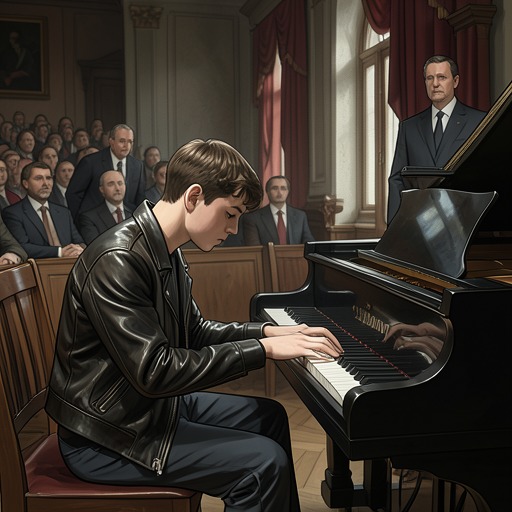
Big BrotherCaleb Fields is a fictional prodigy on the television series Joint Custody, remembered as a fourteen-year-old jazz pianist and ambitious rebel. His place in the memoir is less as an independently developed character than as a screen image through which Edison Appaloosa measures his own musical aspirations, appearance, and experience of being dismissed.
Identity and Design
Caleb was conceived as a precocious pianist who took the road less traveled in a period when, as the memoir recounts, most young people wanted to become rock stars. His jazz expertise was part of the show’s construction rather than proof of the actor’s musicianship: the narrator compares Sinclair Vanpelt’s portrayal to fictional fluency conjured by a few foreign phrases, observing that the actor could not master a minor seventh.
Ambition and Rebellion
At fourteen, Caleb is the eldest of three children and the family’s rebel. He pursues a parallel life as a hep cat in dark clubs in Old Town and the Pearl District, where he must keep his status as a minor quiet. His ambition to leave both parents behind made him identifiable to adolescent viewers. The character’s polished independence sits within a family premise organized around parents who dislike each other and the children’s difficult shuttling between households.
Caleb’s screen image also supplies a model of jazz as a route to recognition. Edison may have taken the character’s hipness, together with the genre’s place in the early 1970s, as evidence that jazz could lead to fame. In the narrator’s account, that impression helps make sense of Edison’s later bitterness about jazz’s marginal position and the tiny market share available to its practitioners.
Edison and the Actor
Caleb’s appearance recalled Edison in adolescence. Both had lanky builds and long, loosely curling hair; Caleb’s was brown, Edison’s dirty blond, and Edison continued to style his hair like the character’s. The resemblance made Caleb more than a television role in the family’s memory: the fictional pianist appeared to reflect the real brother’s former looks and ambitions.
A studio encounter turned that resemblance into a source of lasting resentment. While the family waited around the studio before an NBC picnic in Griffith Park, Edison demonstrated crossed-hand piano playing to Sinclair. The demonstration asserted Edison’s real musical knowledge against the show’s performed expertise, but Sinclair responded with laughter and called the situation droll. Edison’s enmity toward the actor endured. The episode exposes the distance between Caleb’s scripted musicianship and Edison’s lived commitment to jazz, while showing how the television production could make the siblings feel like extras in their own family’s orbit.
Narrative Significance
Caleb connects the novel’s family history to its reflection on television, celebrity, and cultural recognition. The character’s rebellious style offers an appealing fantasy of self-invention, but the memoir complicates it by contrasting fictional aptitude with actual skill and fame with the precarious standing of jazz. Through Caleb, Edison’s youthful identification with a screen character becomes both a source of aspiration and a reminder of the humiliations attached to that identification.